
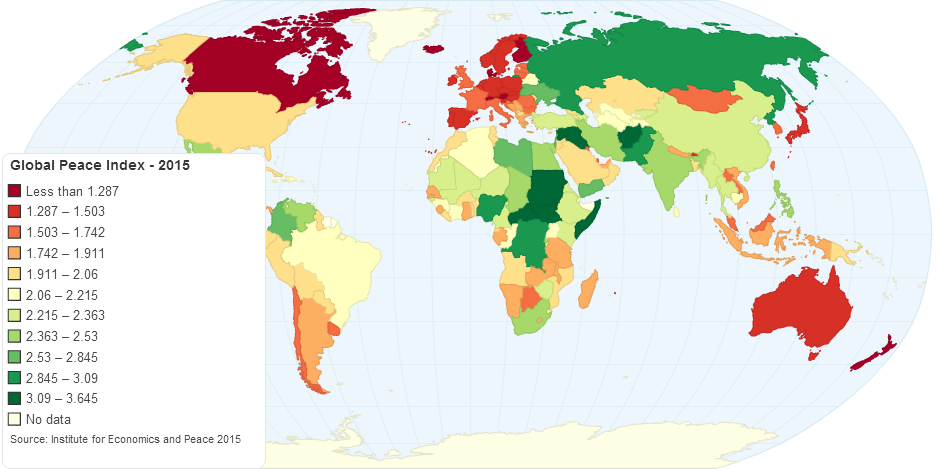
This map shows the Global Peace Index (GPI) rankings for the 162 countries around the world in indicators covering crime, terrorism, government, democracy and respect for human rights. A lower score indicates a more peaceful country.
Key Findings of 2015:
- Since last year, 81 countries have become more peaceful, while 78 have deteriorated.
- Many countries in Europe, the world’s most peaceful region, have reached historically high levels of peace. 15 of the 20 most peaceful countries are in Europe.
- Due to an increase in civil unrest and terrorist activity, the Middle East and North Africa is now the world’s least peaceful region for the first time since the Index began.
- Globally the intensity of internal armed conflict has increased dramatically, with the number of people killed in conflicts rising over 3.5 times from 49,000 in 2010 to 180,000 in 2014.
- The economic impact of violence reached a total of US$14.3 trillion or 13.4% of global GDP last year.
- The most peaceful countries are Iceland, Denmark and Austria.
- The countries that made the biggest improvements in peace over the last year, generally benefited from the ending of wars with neighbours and involvement in external conflict. The biggest improvers were: Guinea-Bissau, Cote d’Ivoire, Egypt and Benin.
- Syria remains the world’s least peaceful country, followed by Iraq and Afghanistan.
- The country that suffered the most severe deterioration in peace was Libya, which now ranks 149th of 162 countries.
- Ukraine suffered the second largest deterioration: following a popular revolution which brought down the administration of Viktor Yanukovych, Russia moved to destabilise the country, meaning it scored poorly on organised conflict indicators.
What is Global Peace Index?
The Global Peace Index (GPI), the first ever study to rank the nations of the world by their peacefulness and to identify potential drivers of peace, is a core asset of the Institute. It is maintained by the Institute for Economics and Peace and developed in consultation with an international panel of peace experts from peace institutes and think tanks with data collected and analysed by the Economist Intelligence Unit.
How is the Peace Index calculated?
The Global Peace Index is calculated on the basis of 23 indicators (see the list below) of the existence or absence of peace were chosen by the panel of experts, which are divided into three broad categories: measures of ongoing domestic and international conflict, measures of safety and security in society and measures of militarization. All scores for each indicator have now been “banded”, either on a scale of 1-5 (for qualitative indicators) or 1-10 (for quantitative data, such as military expenditure or the jailed population, which have then been converted to a 1-5 scale for comparability when compiling the final index). Qualitative indicators in the index have been scored by the Economist Intelligence Unit’s extensive team of country analysts, and gaps in the quantitative data have been filled by estimates by the same team.
- Measures of ongoing domestic and international conflict
- Number of external and internal conflicts fought: 2004-09
- Estimated number of deaths from organized conflict (external)
- Number of deaths from organized conflict (internal)
- Level of organized conflict (internal)
- Relations with neighbouring countries
- Measures of societal safety and security
- Perceptions of criminality in society
- Number of displaced people as a percentage of the population
- Political instability
- Level of disrespect for human rights (Political Terror Scale)
- Potential for terrorist acts
- Number of homicides per 100,000 people
- Level of violent crime
- Likelihood of violent demonstrations
- Number of jailed population per 100,000 people
- Number of internal security officers and police per 100,000 people
- Measures of militarization
- Military expenditure as a percentage of GDP
- Number of armed services personnel per 100,000 people
- Volume of transfers (imports) of major conventional weapons per 100,000 people
- Volume of transfers (exports) of major conventional weapons per 100,000 people
- Funding for UN peacekeeping missions: outstanding contributions versus annual assessment to the budget of the current peacekeeping missions
- Aggregate number of heavy weapons per 100,000 people
- Ease of access to small arms and light weapons
- Military capability/sophistication
Updated: for 2015 (17th November 2015)
11 years ago

